
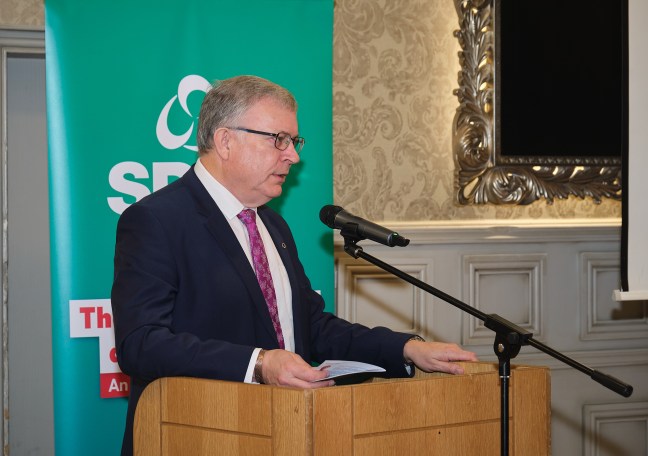
Transcript of the speech by SDLP MLA for Mid Ulster, Patsy McGlone, in the NI Assembly on Tuesday 19th May 2026.
Official Assembly Hansard Report 19 May 2026
“I welcome the opportunity to set out the SDLP’s position on addressing the legacy of the past. Our position will not be a surprise to anyone, as we are among the few who have been consistent throughout the decades when dealing with past. We do not support the motion. It is important that we put on record that those who continue to perpetuate the myth that any one group of actors from the Troubles is being disproportionately pursued do a grave disservice to the rule of law. They are propagating falsehoods that hinder society’s ability to uncover truth, deliver justice and, ultimately, achieve reconciliation.
“Since 2012, there have been just 25 prosecutions for Troubles-related offences. Of those, more than half concerned paramilitary actors, while fewer than a quarter involved MOD personnel. Those seeking to wreck the Troubles Bill — we have heard them over in Westminster — are not acting out of any honour-bound duty to the security service; their aim, by consequence, is to suppress truth, conceal evidence of collusion and distort the historical narrative. History will acknowledge that this was a dirty war in which loyalist and republican paramilitaries were involved but also, at times, actors of the state.
“We know how agents such as Freddie Scappaticci and Brian Nelson were handled. We know of the actions of the British paratroopers on the streets of Derry, Ballymurphy and the Shankill Road. I am under no illusion that it suits both state and non-state actors to obscure the truth, evade accountability and bend the rule of law. Indeed, what we witnessed in Dunmurry a few weeks ago was a manifestation of the continued glorification of past violence. At this point, the quote attributed to Albert Einstein is very appropriate: the definition of insanity is doing the same thing over and over again and expecting different results. By contrast, memorialisation carries responsibility and demands recognition of wrongdoing, acknowledgement of injustice and, where appropriate, an apology.
“In Dunmurry and Lurgan, public servants in the PSNI, along with residents and businesses, were attacked by organised criminals. Their vision offers nothing to the people of Ireland — no prosperity or better future — only destruction, fear and hopelessness, and certainly not unity of the people of Ireland.
“Let me be absolutely clear: violence was never inevitable. Those who directed it made a choice. Violence is not inevitable today, either. Those who engage in it now also make a choice. The people of Ireland rejected violence throughout the Troubles, just as they reject it now. One issue will determine our success in addressing the legacy of the past: disclosure. Security institutions must accept that collusion is, in itself, a crime; one that demands accountability. National security vetoes cannot be used to conceal evidence of collusion or double standards. The absence of full disclosure has long failed victims and their families; families like that of Sean Brown and those of the disappeared.
“On Sunday, I attended the launch of a book on the investigation into the murder of Sean Brown. Among 25 people who were involved in the murder, a number were agents of the state. He was an innocent man. Victims, and society as a whole, deserve the full and unvarnished truth. Anything less leaves only half-truths, revisionism, continued pain and justice denied. It is equally important that disclosure sheds light on how non-state actors operated with impunity and how, for many, the direction of violence was not about political ideals but about power, control, personal gain and dominance over the very communities that they claimed to defend.
“The dirty war that was waged by all sides must be brought fully into the light. Too often, the reality is not one of noble causes or heroic acts but of brutality, sexual violence that was hidden behind kangaroo courts, women being intimidated for rebuilding their lives, children being abused by those wielding unchecked power, communities being driven out and thousands of people being forced to leave the North simply to live in peace.
“We must also ensure that independence is the foundation of any legacy commission or information recovery body. For decades, London, Dublin and republican and loyalist organisations have sought to shape legacy processes and control narratives, often because they had the most to lose. Addressing the legacy of the past extends beyond legislation in London or Dublin: it shapes our politics, our community relations, our policing and the capacity of our devolved institutions to deliver for the future. We cannot afford another missed opportunity.”
ENDS
 Your MLA